Key Takeaways
- Displayed depth is a live view of resting limit orders - not a complete map of supply and demand.
- An iceberg is a legitimate order type that displays only part of a larger order and reveals more as the visible portion executes.
- Spoofing involves entering orders with the intent to cancel before execution in order to mislead other participants; intent is the defining element.
- A large order that disappears is not automatically a spoof. Legitimate orders are frequently modified or cancelled as conditions change.
- A depth snapshot cannot reliably detect an iceberg because the hidden quantity is not published. Detection tools infer possible icebergs from execution and replenishment patterns.
- “Real liquidity” is best assessed through displayed depth, spread, executed volume, replenishment, slippage and price response - not a single wall on the book.
- Crypto order books are venue-specific, so one exchange does not represent the full market.
Direct Answer
The order book can tell you where limit orders are currently displayed, how much size is visible at each price, the current bid-ask spread and how that displayed depth changes over time. It can help identify where price may meet liquidity and whether orders are being added, cancelled, consumed or replenished.
It cannot tell you whether those orders will still be available when price reaches them, how much hidden liquidity sits behind an iceberg, who owns the orders or what the participant intends to do. It also cannot prove spoofing from a screenshot or one cancellation because spoofing is defined by intent to cancel before execution.
The practical distinction is straightforward: an iceberg hides liquidity that is intended to trade, while spoofing displays liquidity that is not intended to trade. Public order-book data can suggest either pattern, but it rarely proves the hidden quantity or the participant’s intent.
Educational content only. This article does not constitute investment advice or a recommendation to buy or sell any financial instrument. Trading and crypto-assets involve substantial risk.
What Is an Order Book?
An order book is a continuously updated list of resting buy orders, called bids, and sell orders, called asks, for a particular market on a particular venue. The highest bid and lowest ask form the top of the book, and the difference between them is the bid-ask spread. The quantity displayed at each price forms the visible market depth.
Those entries are limit orders. A buy limit order specifies the highest price a participant will pay; a sell limit order specifies the lowest price a participant will accept. A marketable order crosses the spread and executes against available resting liquidity.
The order book is therefore a view of current displayed interest, not completed trading. Time and sales, footprint charts and volume delta describe executions. A robust liquidity read combines both sides: what participants display and what actually trades.
Displayed Depth Is Not Total Liquidity
Displayed depth is useful because it shows executable quotes available at that moment. It can reveal whether the visible book is thick or thin, where large concentrations of orders sit and how the balance between bids and asks changes. But the snapshot is incomplete for three reasons.
First, some order types deliberately hide quantity. Coinbase’s published trading rules, for example, state that its iceberg limit order displays a trader-defined portion while the remainder stays confidential and refreshes after the visible portion fills. CME and Nasdaq documentation describe comparable displayed-and-reserve structures.
Second, visible orders can be modified or cancelled before execution. A large bid is not a promise that someone will buy when price reaches it. It is an executable instruction while it remains active, subject to the venue’s rules and the participant’s ability to change or cancel it.
Third, liquidity is dynamic. New orders can appear as price approaches, displayed size can replenish after execution and liquidity can migrate between venues. For practical analysis, spread, depth, trading cost and price impact should be evaluated together rather than treating book depth as a sufficient liquidity measure.
What Is an Iceberg Order?
An iceberg is a limit order that contains a visible portion and a larger hidden or reserve portion. Only the displayed amount appears in public market data. When that amount executes, another portion may be released until the reserve is exhausted or the order is cancelled.
The purpose is usually execution rather than deception. A participant with a large order may not want to display the full size because revealing it could influence other traders, increase market impact or worsen execution. Exchanges and trading platforms provide iceberg or reserve functionality for that reason.
An iceberg is not automatically bullish or bearish. A buy iceberg can absorb seller-aggressive flow at its limit price; a sell iceberg can absorb buyer-aggressive flow. It can eventually be fully executed, partially filled, moved or cancelled like other limit-order interest.
Native and synthetic icebergs
A native iceberg is managed by the exchange’s matching engine. The exchange knows the total order, but the public feed normally shows only the displayed portion. Venue rules determine how refreshed quantity is prioritised in the queue.
A synthetic iceberg is managed by external software. Instead of submitting one exchange-native reserve order, an algorithm sends a sequence of smaller child orders as earlier portions fill. To other participants, repeated child orders at the same price may resemble a native iceberg, ordinary replenishment or several unrelated orders.
This distinction matters because the available market-data feed affects what can be inferred. Market-by-order data may expose more of the event sequence than aggregated market-by-price data, but even high-quality public data cannot reveal the original hidden quantity with certainty.
How Icebergs Appear
A single order-book snapshot cannot establish that an iceberg exists. Hidden size is hidden by design, and the visible portion can look like any ordinary limit order before it trades.
Possible iceberg behaviour becomes observable only as the market interacts with a price. Common clues include:
- Executed volume at a price substantially exceeds the size that appeared to be displayed there.
- A similar displayed quantity repeatedly refreshes after partial or complete fills.
- Aggressive trades continue hitting the level, yet price makes limited progress.
- The level persists through repeated executions rather than disappearing before contact.
- Time-and-sales data show sustained transactions at the price while the visible queue remains present.
These are clues, not proof of the full hidden quantity. Replenishment may come from one reserve order, an execution algorithm, several participants or new discretionary orders arriving at the same level. Detection software estimates the most plausible explanation from the event sequence.
What Is Spoofing?
In U.S. futures law, spoofing is commonly defined as bidding or offering with the intent to cancel the bid or offer before execution. The CFTC identifies that intent as the central element of the prohibited conduct.
The typical concept is that a participant displays non-bona-fide interest to create a misleading impression of supply or demand, may seek an execution on the opposite side, and then cancels the misleading order. Layering is a related pattern involving multiple orders at different price levels that create the appearance of changing market depth.
Crypto-exchange rules can also expressly prohibit spoofing and layering. Coinbase International Exchange, for example, lists both among prohibited forms of market manipulation.
Legal definitions and enforcement standards vary by jurisdiction and venue. The essential editorial safeguard is not to call a specific order or trader a spoofer based on chart behavior alone. That is a claim about intent and potentially unlawful conduct - something a public depth feed cannot establish by itself.
Why Cancellation Is Not Proof
Legitimate market participants cancel orders for many reasons. Their valuation may change, volatility may increase, correlated markets may move, inventory limits may be reached or the risk of adverse selection may rise. A limit order can be genuine when submitted and still be cancelled before it fills.
This is why a large order disappearing as price approaches is only an observation. It may be consistent with spoof-like behaviour, but it may also reflect normal quote management. U.S. spoofing analysis focuses on the participant’s intent when the order was entered, not merely the fact that it was later cancelled.
Regulators can investigate patterns unavailable to an ordinary chart user: account ownership, order identifiers, repeated placement and cancellation, fill ratios, opposite-side executions, timing, communications and activity across linked accounts. A trader viewing Level 2 data normally sees only part of that evidence.
The correct language is therefore:
- Observed: a large offer appeared, influenced displayed depth and was cancelled before price reached it.
- Possible interpretation: the sequence resembles behaviour associated with spoofing.
- Not established: who placed it, whether it was intended to execute or whether manipulation occurred.
Iceberg vs. Spoofing
The contrast is almost inverse. An iceberg can make the book look thinner than the liquidity willing to execute. Spoofing can make the book look deeper than the liquidity intended to execute.
What Is “Real” Liquidity?
No single number captures real liquidity. In practical terms, liquidity is the ability to execute a given quantity quickly, near the expected price and without causing excessive market impact. The result depends on order size, venue, spread, visible and hidden depth, volatility and how the book changes while the order executes.
Several measurements answer different questions:
A market can show high trading volume but still be expensive to enter or exit if the spread is wide or depth disappears under pressure. Conversely, a book can look shallow and still absorb a large order if hidden or newly arriving liquidity replenishes at the relevant prices.
“Real liquidity” is therefore not the biggest visible wall. It is the liquidity that remains available and executes when tested.
A Confirmation Framework
The order book becomes more useful when treated as a sequence rather than a screenshot. Use the following framework to separate observable behaviour from unsupported conclusions.
Define the market
Record the exchange, trading pair and instrument. BTC spot, BTC perpetual futures and BTC futures are separate order books with different participants, leverage conditions and venue rules.
In crypto, liquidity is fragmented across exchanges and even across pairs within the same exchange. Research on crypto order books finds that spreads, depth and liquidity conditions vary by venue and quote currency.
Mark the level
Identify the price area before interpreting the depth. A large order near a prior swing, range boundary or high-volume area may be more relevant than a similar order far from current price, but location does not make the order genuine.
Treat the displayed quantity relative to normal size on that specific venue and instrument. A visually large order may be routine in BTC and unusual in a thin altcoin.
Observe persistence
Watch how long the order remains active and whether it follows price. A resting wall that stays in place as price approaches provides different evidence from one that repeatedly moves away from execution.
Persistence is still not intent. Legitimate liquidity providers constantly update quotes as fair value, inventory and volatility change. The task is to record the sequence without assigning a motive prematurely.
Observe interaction
When price reaches the area, compare displayed size with actual trades:
- Does the order execute, cancel or move?
- Does displayed size replenish after fills?
- How much volume trades at the level?
- Does price move through, stall or reject?
- Does the opposite side of the book change at the same time?
Execution is the critical dividing line. Iceberg detection becomes possible only after the market begins trading with the displayed portion. A suspected spoof often disappears before meaningful execution, but one cancellation remains insufficient evidence.
Compare effort and result
Aggressive volume is the effort; price movement is the result. Heavy market buying into a sell level with little upward progress can indicate absorption. Heavy market selling into a bid with little downward progress can indicate the same process in reverse.
If the level repeatedly refreshes and executes, hidden liquidity becomes a plausible interpretation. If displayed size vanishes before contact and price reacts, deceptive depth becomes one possible interpretation - but not a proven fact.
Confirm outside the book
Use executed-order data to test what the depth display suggests:
- Time and sales shows the transactions that completed at the level.
- Footprint data locates bid- and ask-side execution within the bar.
- Delta and CVD show whether aggressive buying or selling accumulated over the selected window.
- Price structure shows whether the level held, broke or gained acceptance.
- Cross-venue comparison shows whether the event was local or broader.
A depth wall unsupported by executions and price response is a weak foundation for a market conclusion.
Define invalidation
State what would disprove the working interpretation. Suspected buy-side absorption weakens if price accepts below the level. Suspected sell-side absorption weakens if price accepts above it. A supposed liquidity wall ceases to matter if it is cancelled, consumed or left behind as the market moves elsewhere.
Invalidation prevents the analyst from preserving a narrative after the observable conditions have changed.
Four Order-Book Sequences
Displayed liquidity holds
A large bid remains active as price approaches. Seller-aggressive trades execute against it, the displayed amount decreases or refreshes, and price fails to continue lower. This is evidence that executable buy-side liquidity was present and may be consistent with absorption.
It does not reveal whether the orders belonged to one participant, several participants or an iceberg. The defensible conclusion is that the level traded and held during the observed sequence.
Displayed liquidity is consumed
A large offer remains visible, buyer-aggressive trades execute against it and price eventually trades through. The liquidity was real in the narrow sense that it executed, but it was not sufficient to stop the move.
This is an important distinction: real liquidity does not mean permanent support or resistance. Every resting order has finite size unless new orders continue to replenish it.
Displayed liquidity disappears
A large bid or offer is cancelled or moved before price reaches it. The visible book becomes thinner and price may move quickly into the space.
That sequence can matter tactically because the expected liquidity is no longer available. But the cancellation does not reveal why the participant moved the order, so it should not automatically be labelled spoofing.
Hidden liquidity replenishes
Only modest size is displayed at a price, yet substantially more volume executes there while the displayed quantity repeatedly refreshes. Price makes limited progress despite sustained aggressive flow.
This pattern is consistent with an iceberg, reserve order or repeated liquidity provision. The exact hidden quantity and participant identity remain unknown unless the venue supplies additional privileged data.
The Crypto Context
Fragmented order books
Each centralised crypto exchange maintains its own book. A large BTC bid on one venue may be absent elsewhere, and liquidity can move as arbitrageurs respond across markets. Academic research describes Bitcoin as fragmented across multiple coexisting order books.
This means “the Bitcoin order book” is usually an oversimplification. Always name the exchange, pair and instrument. An aggregated heatmap can broaden the view, but differences in update speed, depth, symbol definitions and data quality still matter.
Spot and perpetual markets
Spot and perpetual books can show different depth because they serve different forms of participation. A wall on a perpetual exchange may reflect leveraged positioning or derivatives-market inventory, while a spot order represents interest in the underlying asset on that venue.
Compare related markets when the decision depends on broad liquidity. Agreement across major spot and perpetual venues can make a local observation more informative; disagreement can reveal that the event is concentrated rather than market-wide.
Fast cancellations
Crypto markets trade continuously and rely heavily on automated quoting. Orders can appear, move and disappear faster than a manual observer can process. A static screenshot removes the event sequence that is most important for distinguishing displayed, executed and replenishing liquidity.
Use historical depth only if it preserves sufficient update granularity. Minute-level snapshots may be useful for broad conditions but can miss the rapid placement, execution and cancellation sequence relevant to spoofing or iceberg inference.
Venue rules
Order types and market-data feeds vary by exchange. Some venues offer native iceberg orders; others may require participants to simulate them through an execution algorithm. Priority rules for refreshed quantities also differ.
Before interpreting a pattern, check what the venue actually supports and what the chosen data feed contains. An analysis method designed for market-by-order futures data may not transfer cleanly to aggregated crypto depth.
Common Mistakes
- Treating the largest visible bid as guaranteed support.
- Treating the largest visible offer as guaranteed resistance.
- Calling every cancelled wall spoofing.
- Calling every replenishing level an institutional iceberg.
- Assuming hidden liquidity is unlimited because a price has held repeatedly.
- Reading one snapshot instead of the sequence of additions, trades and cancellations.
- Ignoring the spread, slippage and order size while discussing liquidity.
- Mixing spot and perpetual order books without labelling them.
- Treating one crypto exchange as a consolidated market.
- Using order-book imbalance without checking whether the underlying orders execute.
- Inferring participant identity or intent from anonymous public data.
A Practical Checklist
Before using an order-book observation, document:
- Venue: Which exchange produced the data?
- Instrument: Spot, perpetual or dated futures?
- Pair: Which base and quote assets?
- Feed: Top of book, market by price or market by order?
- Scope: How many price levels are included?
- Persistence: How long did the order remain visible?
- Interaction: Did it execute, replenish, move or cancel?
- Response: Did price stall, break or reject?
- Cross-check: What did time and sales, footprint or CVD show?
- Comparison: Did related venues show the same event?
- Invalidation: What subsequent behaviour would disprove the interpretation?
This checklist does not turn book behaviour into certainty. It makes the conclusion traceable to observable data.
Apply the Framework
Start by separating three layers. Displayed liquidity is what the book currently shows. Executed liquidity is what actually trades when the market reaches a price. Hidden liquidity is what may be available but is not fully visible in the public feed.
Then use neutral language. Describe an order as added, cancelled, executed or replenished before deciding what it might mean. Reserve “spoofing” for the regulatory concept involving intent, and use “spoof-like behaviour” only when a repeated sequence resembles the pattern but intent is not established.
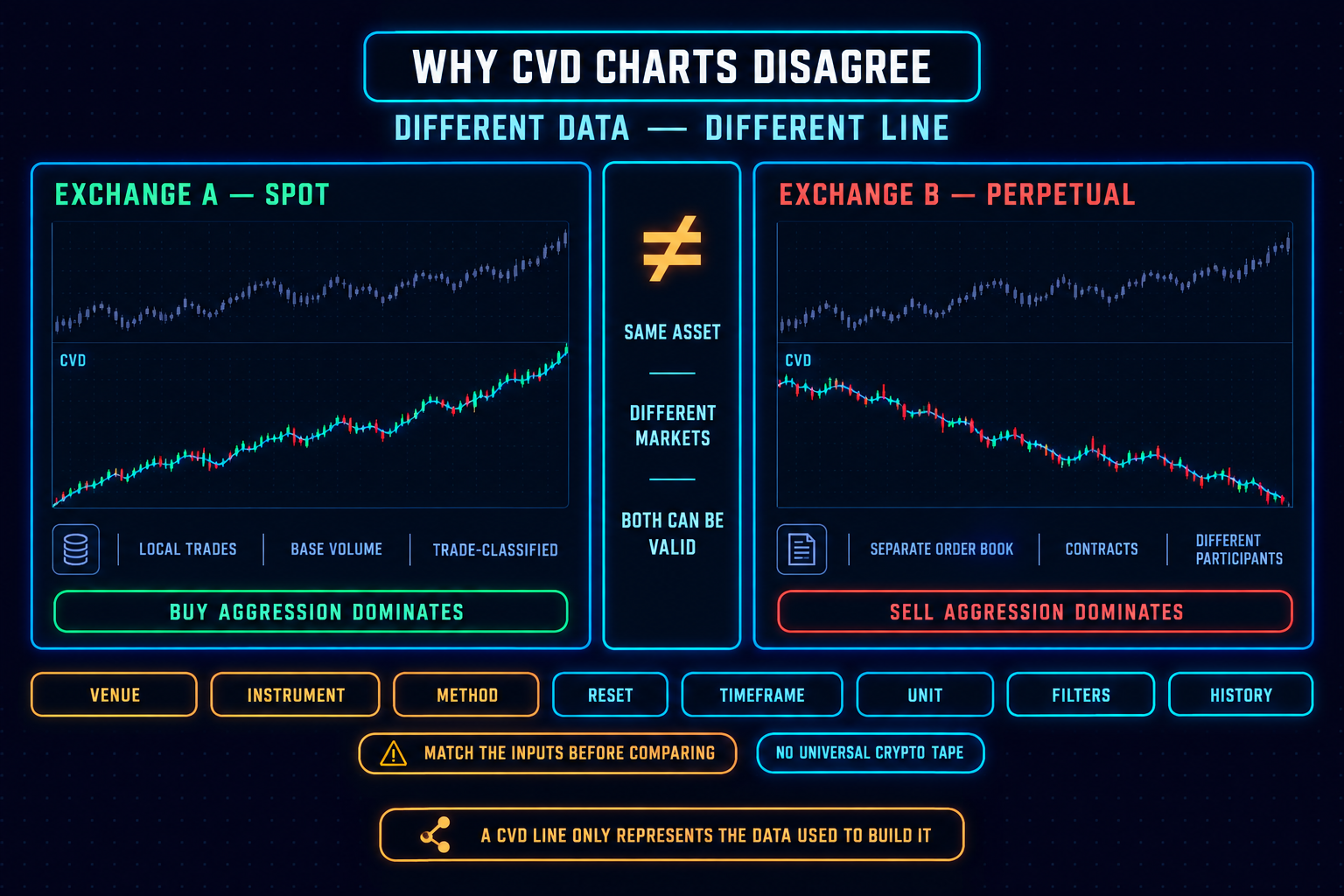
MindPillar’s existing multi-exchange CVD guide explains why a single exchange should not be treated as the entire crypto market. The same rule applies to order-book depth: always match the interpretation to the venue, instrument and data feed.
The practical rule is simple: trust executed behaviour more than displayed size - and never confuse a market-data clue with proof of intent.
Risk Disclaimer (YMYL): This article is for educational purposes only and does not constitute financial, investment or legal advice. Crypto trading carries significant risk of loss. Order-book patterns, iceberg estimates and suspected spoof-like behaviour are uncertain and do not guarantee future price movements. Apply independent analysis and risk management, and consult qualified advisers where appropriate. MindPillar does not manage funds or guarantee profits.
Frequently Asked Questions
Are iceberg orders illegal?
No. Icebergs are recognised order types offered by exchanges and trading platforms. They are designed to limit information leakage and market impact while seeking genuine execution.
Can a heatmap detect iceberg orders?
It can help infer possible hidden liquidity after repeated executions and replenishment occur at a price. A static depth snapshot cannot reveal the hidden quantity, and even dynamic detection remains an estimate unless the exchange provides more complete information.
Can an order-book heatmap detect spoofing?
A heatmap can reveal where liquidity appeared, moved or disappeared and can help identify repeated suspicious-looking patterns. It cannot prove the intent behind an order. That normally requires fuller event data, participant-level records and contextual investigation.
Is visible order-book depth the same as market liquidity?
No. Visible depth is one liquidity measure. A fuller assessment also considers spread, execution cost, slippage, price impact, hidden interest and how depth changes under pressure.
Is every cancelled large order a spoof?
No. The defining issue is the participant’s intent when entering the order. Legitimate orders may be cancelled because market conditions or risk assessments change. One cancellation does not prove manipulation.
What does an order book show?
An order book shows current bids and asks for a specific market on a specific venue, including the prices and displayed quantities available at each level. It does not show all hidden liquidity or guarantee that visible orders will remain active.
What is spoofing?
In U.S. futures regulation, spoofing means bidding or offering with the intent to cancel before execution. It is a prohibited disruptive trading practice. Other jurisdictions and exchange rulebooks may use related definitions and enforcement standards.
What is an iceberg order?
An iceberg is a limit order that displays only part of its total quantity. As the displayed portion fills, more of the hidden reserve may be released according to the venue’s rules.
What is the difference between absorption and an iceberg?
Absorption describes an outcome: aggressive orders execute but produce limited price progress because opposing liquidity continues to meet them. An iceberg is one possible mechanism supplying that liquidity. Absorption can also come from several ordinary limit orders or newly arriving orders.
Why do exchange order books disagree?
vEach venue has its own participants, orders, fees, matching rules and inventory. Crypto liquidity is fragmented across exchanges and trading pairs, so different books can show different spreads and depth at the same time.
Risk Disclaimer (YMYL): This article is for educational purposes only and does not constitute financial or investment advice. Crypto trading carries significant risk of loss. Past pattern performance does not guarantee future results. Always apply your own risk management and consult a qualified financial advisor before trading. MindPillar does not manage funds or guarantee profits.


Author

Dewald built the D-Line system after years of doing what most traders do: chasing indicators, buying courses, following signals, and still losing consistency.
The turning point came when he stopped trying to predict markets and started reacting to them with a plan. Clear structure, fixed risk, a checklist followed every single time.
That framework became the foundation of MindPillar. His teaching style is calm, direct, and system-driven. No hype, no predictions, just a repeatable process you can own.