Key Takeaways
Daily and weekly CVD can use the same order-flow data while displaying different cumulative values.
Daily CVD resets at the start of each defined day.
Weekly CVD resets at the start of each defined week.
Daily CVD places greater emphasis on recent activity.
Weekly CVD preserves volume delta accumulated during earlier days.
Daily CVD can be negative while weekly CVD remains positive.
A reset period should match the window being studied.
Timezone and platform settings can change when daily and weekly resets occur.
Neither reset predicts future price direction.
Direct Answer
Daily and weekly CVD use the same basic calculation but begin accumulating volume delta at different times. Daily CVD measures the balance since the current day began, while weekly CVD includes all classified volume delta recorded since the beginning of the week.
Neither reset is universally better. The appropriate choice depends on whether the analysis concerns recent intraday activity or the broader multi-day balance.
Educational content only. This article does not constitute investment advice or a recommendation to buy or sell any financial instrument. Trading and crypto-assets involve substantial risk.
A quick CVD recap
Cumulative Volume Delta, or CVD, tracks the running difference between buyer-initiated and seller-initiated trading volume.
Volume delta can be expressed as:
Volume Delta=Aggressive Buy Volume−Aggressive Sell Volume
CVD adds each new period’s volume delta to the previous cumulative value:
CVDt=CVDt−1+Volume Deltat
A reset returns that running total to zero and begins a new cumulative window. CVD implementations commonly continue accumulating until the selected anchor period changes.cmegroup+1
The underlying trades do not change when the reset changes. Only the period included in the cumulative calculation changes.
What is daily CVD?
Daily CVD resets at the beginning of each defined day.
It answers the question:
What is the balance of classified aggressive buying and selling since this day began?
If buyer-initiated volume has exceeded seller-initiated volume since the reset, daily CVD will be positive. If seller-initiated volume has dominated, it will be negative.
Daily CVD emphasizes recent activity because it does not carry the previous day’s cumulative balance into the new day.
Daily CVD emphasizes
- Intraday changes in aggressive flow
- The current day’s net volume delta
- Differences between individual trading days
- Whether recent activity differs from previous sessions
- Shorter-term relationships between price and CVD
Daily CVD excludes
- Volume delta accumulated before the daily reset
- The broader balance established earlier in the week
- Continuity from one day into the next
Daily CVD does not erase historical trades. It simply starts a new cumulative calculation.
What is weekly CVD?
Weekly CVD resets at the beginning of each defined week.
It answers:
What is the cumulative balance of classified aggressive buying and selling since this week began?
Weekly CVD carries Monday’s delta into Tuesday, Tuesday’s into Wednesday and so on until the next weekly reset.
A strong positive imbalance early in the week can therefore continue influencing weekly CVD even if later days produce negative delta.
Weekly CVD emphasizes
- Multi-day order-flow balance
- Whether recent activity is large relative to earlier activity
- The cumulative contribution of several trading days
- Broader changes in aggressive volume during the week
- Continuity between daily sessions
Weekly CVD can obscure
- Smaller intraday changes
- Short-lived reversals in aggressive flow
- The importance of the current day when earlier volume was much larger
Weekly CVD contains more history, but that does not make it more accurate for every analytical question.
Daily vs. weekly CVD
These are different views of the same type of data. They are not competing indicators.
Why they can disagree
Daily and weekly CVD can point in opposite directions because they start from different boundaries.
Imagine the following hypothetical delta values:
On Thursday:
- Daily CVD is negative because Thursday has recorded −250 since its daily reset.
- Weekly CVD remains positive because the positive delta from Monday and Tuesday still exceeds the selling recorded on Wednesday and Thursday.
The observations describe different windows:
- Daily CVD: Aggressive selling has dominated today.
- Weekly CVD: Classified buying remains dominant across the full week.
Neither observation proves how price will respond next.
Which reset should you use?
Use the reset that matches the question you are asking.
Use daily CVD when
- The focus is current-day activity.
- You want to compare separate days.
- Earlier weekly activity is overwhelming recent changes.
- You are studying intraday price behavior.
- You want to see when today’s aggressive flow changes direction.
Use weekly CVD when
- The focus is broader multi-day activity.
- You want to retain earlier sessions in the calculation.
- You are evaluating whether today’s flow is large relative to the week.
- You want to study cumulative pressure across several days.
- Daily resets remove context that matters to the analysis.
Compare both when
- Daily CVD contradicts the broader weekly balance.
- A recent shift needs to be viewed in context.
- You want to distinguish a one-day change from a multi-day change.
- The current day appears significant, but earlier flow remains influential.
Comparing both resets can add context, but it does not create new order-flow data. It reorganizes the same history into two cumulative windows.
A simple framework
A practical way to read both charts is to begin with the broader window and then inspect the shorter one.
- Check weekly CVD: Identify the cumulative balance since the week began.
- Check daily CVD: Observe what has happened since today’s reset.
- Compare the directions: Determine whether recent flow agrees with or opposes the weekly balance.
- Compare with price: Observe whether aggressive volume is producing proportional price movement.
- Avoid assigning intent: Do not assume that disagreement proves accumulation, distribution or trapped traders.
- Define the window: State whether an observation refers to daily or weekly CVD.
This is an interpretation framework, not a trading strategy.
How to describe disagreements
MindPillar’s editorial approach separates direct observations from possible interpretations.
The first column describes what the indicator shows. The second remains conditional because CVD cannot independently identify participant intent or future direction.
Why timezone matters
A daily or weekly reset needs an exact boundary.
One platform may define a day using midnight UTC. Another may use the exchange’s timezone, the user’s local timezone or a configurable session boundary.
Weekly resets may also differ. A platform could begin the week on Sunday or Monday, and the reset may occur at different hours depending on timezone settings.
This is especially relevant in cryptocurrency markets because trading continues throughout the day and week. There is no universal opening bell that naturally resets all crypto order flow.
Before comparing two CVD charts, confirm:
- The exchange or data source
- The instrument
- The reset frequency
- The reset time
- The timezone
- The delta-calculation method
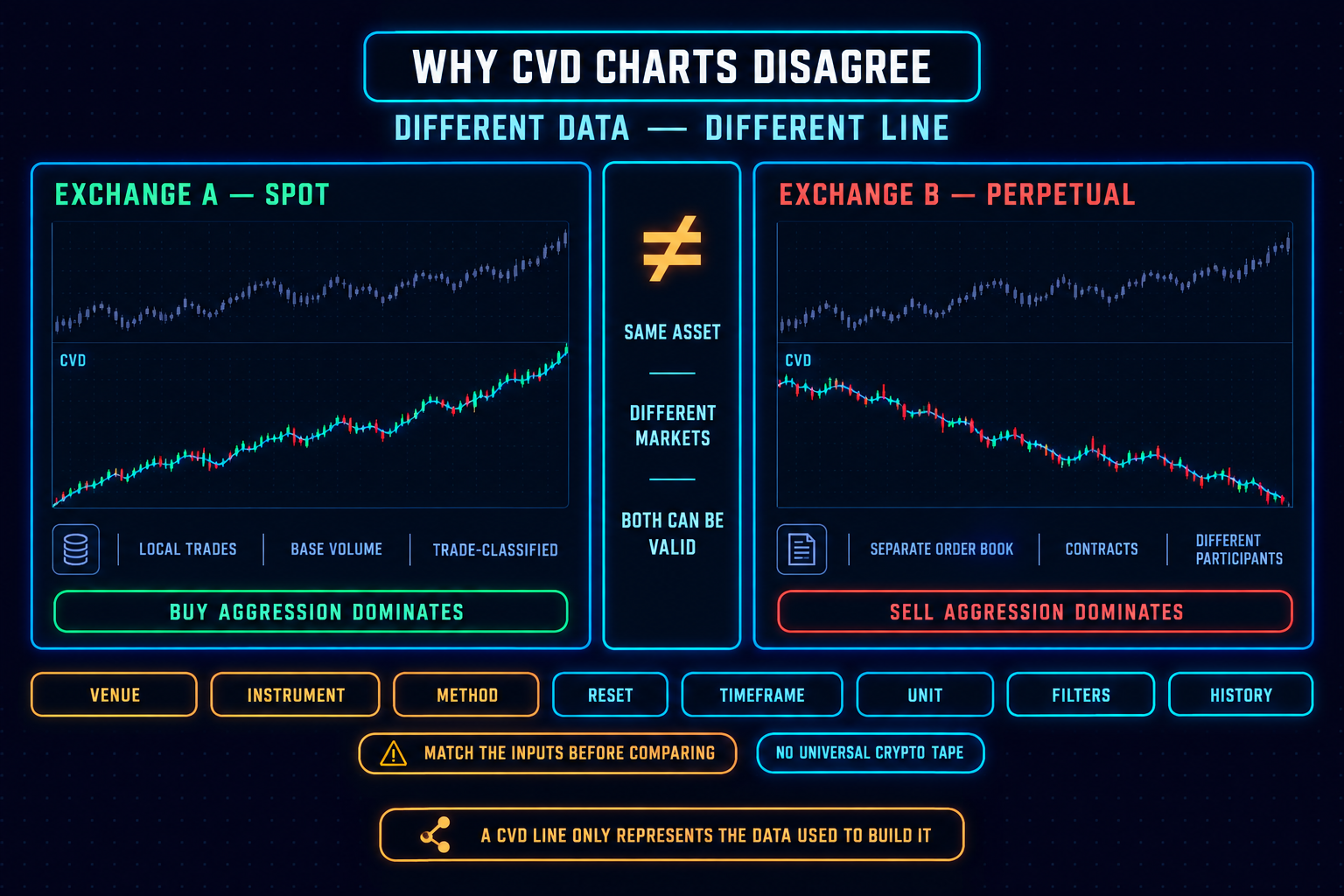
Two indicators labelled “daily CVD” may not include exactly the same trades.
Common mistakes
Assuming weekly CVD is always more reliable
Weekly CVD contains more history, but that history may not be relevant to an intraday question. More data does not automatically mean a more appropriate window.
Treating daily CVD as isolated market truth
Daily CVD describes activity since its reset. It does not show whether that activity is large or small relative to the rest of the week.
Choosing the most attractive chart
Selecting whichever reset produces the clearest divergence or directional narrative introduces selection bias. The reset should be selected before interpreting the result.
Ignoring reset time
Two daily or weekly indicators can disagree because their resets occur at different times.
Comparing absolute values
A daily value of +1,000 and a weekly value of +1,000 do not have the same context. One covers a shorter window, while the other represents cumulative delta across several days.
Treating opposite readings as a signal
Negative daily CVD and positive weekly CVD describe disagreement between windows. They do not automatically create a buy or sell signal.
What the comparison can tell you
Comparing daily and weekly CVD can help describe:
- Whether recent aggressive flow agrees with the broader weekly balance
- Whether one day has materially changed the week’s cumulative result
- How much earlier volume delta influences the current chart
- Why a short-term CVD move looks significant on one reset but small on another
- Whether two analyses are using the same cumulative window
The comparison cannot independently reveal:
- Trader identity
- Participant intent
- Whether positions are opening or closing
- Whether passive liquidity will remain available
- Whether price must reverse or continue
- Which reset will produce better trading results
Frequently Asked Questions
Can daily CVD be negative while weekly CVD is positive?
Yes. Negative delta today may be smaller than positive delta accumulated earlier in the week.
Can I compare daily and weekly CVD divergence?
Yes, but label each observation clearly. A daily divergence and weekly divergence use different cumulative windows and should not be treated as identical evidence.
Does a daily reset erase volume?
No. It starts a new cumulative calculation. The underlying trades and bar-level delta remain part of the historical record.
Is daily or weekly CVD better?
Neither is universally better. Daily CVD is more focused on current-day activity, while weekly CVD provides broader multi-day context.
Should both CVD resets point in the same direction?
Not necessarily. They can disagree because they cover different periods.
When does daily CVD reset?
That depends on the platform’s timezone and configuration. Common boundaries include midnight UTC, midnight local time or the start of a defined session.
When does weekly CVD reset?
It depends on the platform’s definition of the week, timezone and indicator settings. Verify whether the week begins on Sunday or Monday and at what time.
Risk Disclaimer (YMYL): This article is for educational purposes only and does not constitute financial or investment advice. Crypto trading carries significant risk of loss. Past pattern performance does not guarantee future results. Always apply your own risk management and consult a qualified financial advisor before trading. MindPillar does not manage funds or guarantee profits.


Author

Dewald built the D-Line system after years of doing what most traders do: chasing indicators, buying courses, following signals, and still losing consistency.
The turning point came when he stopped trying to predict markets and started reacting to them with a plan. Clear structure, fixed risk, a checklist followed every single time.
That framework became the foundation of MindPillar. His teaching style is calm, direct, and system-driven. No hype, no predictions, just a repeatable process you can own.