.png)
Direct Answer
You already knew you should have stopped. The first stop-out was clean: wrong trade, right decision to exit. But you sat back down and took another. Then another. By the time you closed the platform, what started as a manageable red day had turned into the worst session of the month.
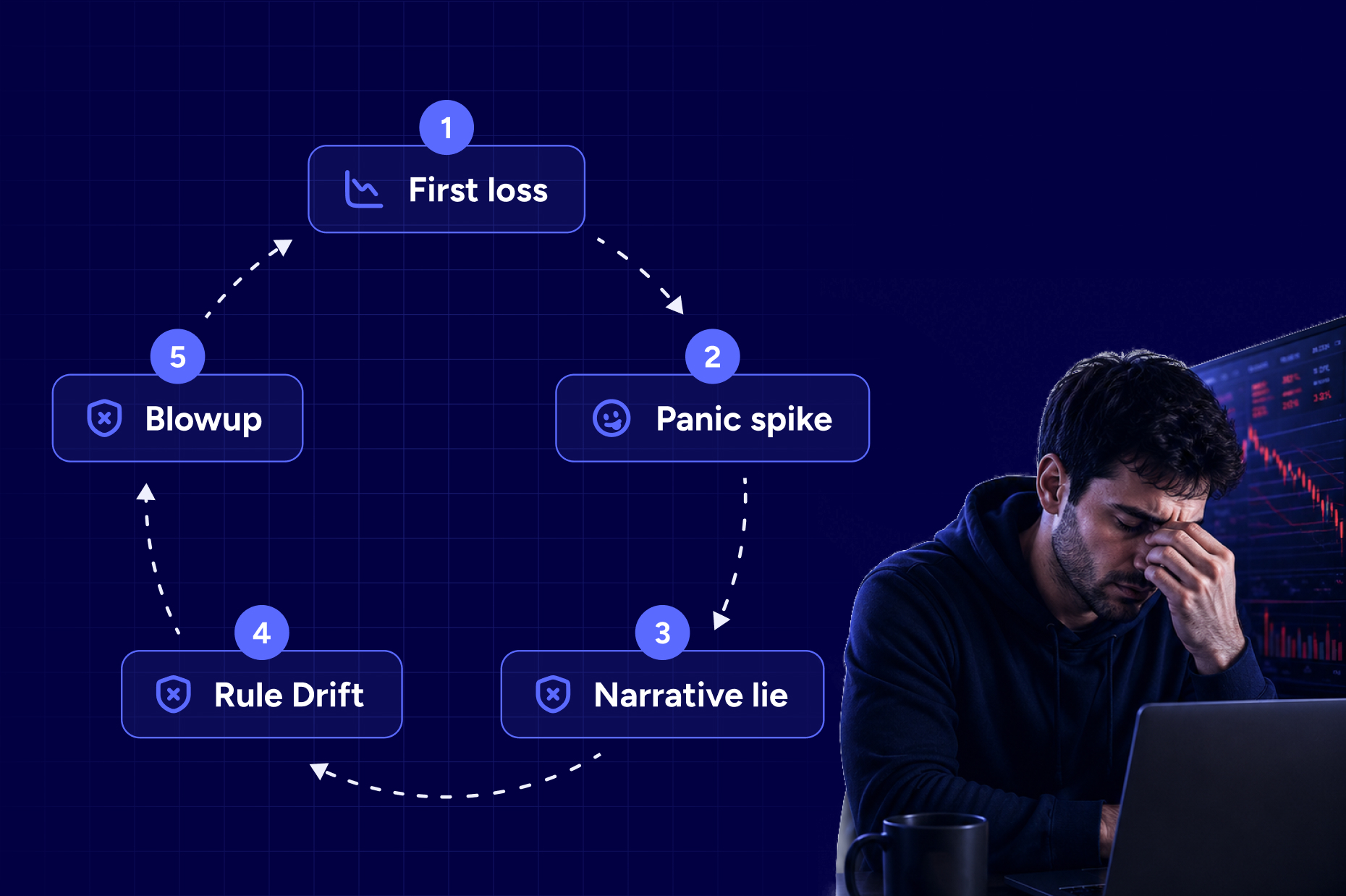
FOMO, revenge trading, and overtrading are three expressions of the same five-stage behavioral sequence: the Pre-Meltdown Behavioral Loop. It starts with a single loss and ends in account damage, running the same way every time. The loop repeats because most traders try to fix it with discipline, when actually practical mechanical rules can help prevent you from reaching the next stage.
You don't have a discipline problem
Every trader who has blown up a session has told themselves the same thing afterward: next time I'll be more disciplined. They journal it, they promise it, some of them tattoo it into their pre-session routine. And then the next red day comes, and the loop runs again.
Discipline isn't the problem. It never was.
The traders who keep revenge trading aren't lacking willpower. Most of them know exactly what they're doing while they're doing it, and they can name the rule they're breaking in real time. The problem is that by the time the second or third trade goes in, the part of the brain responsible for following rules is no longer fully in charge.
And the truth is you’ll find it very hard to out-discipline a neurological response, but you can build systems that account for it.
What actually happens in your brain after a loss
For your brain, a stop-out is more than a simple unfortunate financial event. It actually processes it as a threat.
The moment a loss registers, the amygdala fires (the brain's threat-detection center) and floods the system with cortisol and adrenaline. This is the same stress response that kept your ancestors alive during a moment of tension. It's fast, it's automatic, and it doesn't distinguish between a predator and a losing trade.
What it does do is suppress the prefrontal cortex, the part of the brain that handles rational decision-making, impulse control, and rule-following. Research published in the Proceedings of the National Academy of Sciences found that physiological arousal spikes harder on losses than on equivalent gains, and that this arousal directly predicts loss-averse behavior. In plain terms: your body is already reacting before you consciously decide to take the next trade.
This is why "just be more disciplined" fails. Discipline lives in the prefrontal cortex. By the time you're considering a revenge trade, that system is running at reduced capacity. So that bad decision you’re making? It’s mostly likely because your brain has temporarily handed control to a system built for survival, not for executing a trading plan.
That's why discipline alone won't cut it here. The fix has to work on a brain that's already in that state, not on the calm, rational version of you that sets the rules before the session starts.
The Pre-Meltdown Behavioral Loop
The Pre-Meltdown Behavioral Loop is a five-stage sequence of emotional and behavioral escalation that begins with a single loss and ends in account damage. FOMO, revenge trading, and overtrading are all expressions of stage four and five of this loop.
It runs the same way every time. And it runs whether you're aware of it or not.
Stage 1: First loss
The loop usually starts with a single, ordinary stop-out.
The loss itself doesn't have to be large. A clean stop at your predefined level is still a loss, and the brain doesn't distinguish between a $50 stop-out and a $500 one in terms of threat response.
What matters is that something was taken. The account is now below where it started, and that gap, however small, is what pulls the trigger on everything that follows.
Most traders at this stage feel fine. The loss was planned. The system worked as intended. This is the last moment of the session where the rational brain is fully in control.
Stage 2: Physiological arousal spike
Within seconds of the loss registering, the stress response activates. Cortisol and adrenaline enter the system. The amygdala fires before you've consciously processed what happened.
This is the stage most traders skip over entirely, because it doesn't feel like a decision. It feels like nothing. A slight tightening. A background urgency. The impulse to check the chart again.
But something has already changed. The prefrontal cortex (the part of the brain running your trading plan) is now competing with a survival system that has one job: remove the threat. That system doesn't know the difference between a losing trade and a physical danger. It just knows something bad happened, and it wants it fixed immediately.
Most traders sit back down at the screen right inside this window. That's where the loop takes hold.
Stage 3: Narrative lie
With the rational brain running at reduced capacity, the emotional brain fills the gap with a story. The story always sounds reasonable. That's what makes it dangerous.
The specific lie depends on the trader, but the function is always the same: it authorizes the next trade. Common versions:
- "I'm due for a winner" – gambler's fallacy dressed as probability
- "I can't end the day red" – identity threat overriding process
- "Just one more trade" – the illusion of control with no exit condition
- "I know this setup works" – using a real edge to justify a rule violation
- "I'll be disciplined once I get back to even" – delaying all rules into a future that never comes
None of these are conscious lies. The trader believes them in the moment. That's the point: the arousal spike from Stage 2 has already shifted what feels true.
And pay attention because the narrative isn't actually causing the problem. This is the symptom that tells you Stage 2 already happened.
Stage 4: Rule abandonment
The narrative gets acted on. Stop-losses get widened. Position size increases. A setup that wouldn't pass a pre-trade checklist gets taken anyway.
The trader is no longer executing a system. They're using market activity to manage emotional pain. Every rule that gets bent at this stage makes the next one easier to break, not because the trader has given up, but because each small violation rewrites the reference point for what "following the rules" means in this session.
This is where FOMO, revenge trading, and overtrading diverge in their surface appearance but remain identical in their cause. FOMO takes a late entry to avoid missing the move. Revenge trading sizes up to recover the loss. Overtrading takes trade after trade to stay busy.
Different behaviors, same stage, same driver.
Stage 5: Blowup
The loss compounds. One bad trade becomes three, and a manageable red day becomes the worst session of the month.
The account damage in a meltdown almost never comes from the first losing trade. It comes from trades three, four, and five, taken while the loop was already running at full speed, with no rule left standing to stop it.
This is also the stage that feels the most personal. Traders leave sessions at Stage 5 convinced the problem is who they are: their temperament, their psychology, their ability to handle pressure. It isn't. The loop ran because nothing was built to stop it.
The narrative lies traders tell themselves at each stage
Most trading psychology content lists the lies traders tell themselves as though they're random bad habits. But reality is that each lie maps to a specific stage of the loop, and each one is doing a specific job: authorizing the next action when the rational brain no longer has full control.
Naming them by stage matters because it gives you a diagnostic tool. And being aware is the first step to prevent it from aggravating.
So if you catch yourself running one of these narratives, know you're not simply having a bad thought. You're already inside the loop.
The lies that appear at Stage 2 (arousal spike)
These lies activate immediately after the loss, while the stress response is still fresh. Their job is to keep you at the screen.
"It's fine, I'm not emotional." The most common and most dangerous. Emotional hijacking doesn't feel like losing control, it feels like heightened focus. The trader who is about to revenge trade is often completely convinced they're thinking clearly.
"I just need to watch the chart for a minute." Watching isn't neutral. Every minute you spend staring at a chart after a loss is a minute your brain is scanning for a reason to re-enter. This lie frames passive observation as a safe middle ground, when it’s actually Stage 3 loading.
The lies that appear at Stage 3 (narrative lie)
These are the authorization lies, the ones that turn emotional pressure into a specific trade decision.
"I'm due for a winner." Gambler's fallacy. The market has no memory of your last trade. A losing streak doesn't increase the probability of the next winner. What it does is increase the emotional pressure to find one, which lowers entry standards and raises position size at exactly the wrong time.
"I can't end the day red." The daily loss limit exists precisely for this moment, because the trader who "can't" end red will keep trading until they're significantly more red or accidentally green.
"Just one more trade." There is no exit condition in this sentence. One more trade, by definition, becomes two if it loses. The lie works because it sounds like moderation, but it's an open-ended commitment to keep trading until the emotional need is met, which the market is under no obligation to do.
"I know this setup works." The setup may well work over a large sample of trades. That's not what this sentence is doing. It's using a real edge to justify taking a trade that doesn't meet entry criteria, in a market context that may not support it, with a position size driven by the need to recover rather than by risk management. The edge is real, but the authorization is false.
"I'll be disciplined once I get back to even." Discipline deferred is discipline abandoned. The trader who promises to follow rules after recovering the loss is making that promise from inside a state where rule-following is already compromised. Even if they get back to even (and many do, briefly) the same conditions will produce the same loop the next time a loss hits.
The lies that appear at Stage 4 (rule abandonment)
By Stage 4 the lies shift function. They're no longer authorizing a trade. They're justifying the rules that have already been broken.
"The market is wrong." Sometimes true. During Stage 4, almost always false. The trader who says the market is wrong is usually holding a losing position past their stop, averaging into a move against them, or refusing to accept that their thesis didn't play out on this particular trade. Being early and being wrong look identical from inside a losing position.
"I'll size down on the next one." A future promise made in the present to rationalize current oversizing. The next one rarely gets sized down, because by the time it arrives, the same emotional state is still running.
"This is different from revenge trading." Revenge trading doesn't feel like revenge trading from the inside. It feels like legitimate trading with high conviction. The behavioral signature (oversized position, reduced checklist, urgency to enter) is the same regardless of how the trader labels it.
Why the loop keeps repeating
After a bad session, most traders do the same thing: they close the platform, sit with the loss for a while, and make the decision that “next time will be different”. They journal it. They replay the trades. They identify exactly where it went wrong. And they mean it (genuinely!) when they say they won't do it again.
Then the next red day comes.
This is the part of the loop nobody names. Call it the Reset Myth: the belief that awareness of the problem is the same as having solved it. While it is a first step, it alone won’t fix it.
Knowing what the Pre-Meltdown Behavioral Loop is doesn't stop it from running. Understanding the neuroscience behind Stage 2 doesn't prevent the arousal spike. Being able to list every narrative lie in Stage 3 doesn't stop your brain from generating them when cortisol is elevated and the P&L is negative.
The reset feels productive because it engages the rational brain, the calm, post-session version of you that can analyze clearly and make good decisions. But the loop doesn't run on that version of you. It runs on the version sitting at the screen twenty minutes after a stop-out, physiologically aroused, with the prefrontal cortex running below capacity.
Promising that version of yourself more discipline is like designing a seatbelt and then deciding not to wear it because you're a good driver.
How to break the loop: one mechanical rule per stage
The rules can function as circuit breakers: designed to work on the version of you that is already mid-loop. Each one maps to a specific stage because that's where it has to intervene.
For a deeper look at why trading strategies often ‘work on paper’ but fail in live markets, and how a rule‑based process closes that gap, see our article on why your trading strategy keeps failing.
After the arousal spike: the mandatory cooldown
Stage 2 is where the loop takes hold, and it's the stage with the smallest window to interrupt it. The mandatory cooldown is the only rule that operates here.
After any stop-out, close the order ticket. Set a timer for 30 minutes. Do not reopen the chart during this window.
Don’t think of this as a mindset exercise. The cooldown works because the prefrontal cortex begins recovering the moment you step away from the screen. Thirty minutes of physical distance from the platform is enough to meaningfully reduce the arousal spike from Stage 2, which means Stage 3 either doesn't load, or loads with less force.
The rule has to be written down before the session starts, with no exceptions built in. "I'll step away unless the setup is really strong" is not a cooldown rule. It's a Stage 3 narrative lie with a timer attached.
Rule format: After any losing trade, I close the order ticket and do not reopen it for 30 minutes. No exceptions.
Before the narrative lie lands: the pre-trade checklist
The narrative lies in Stage 3 share one weakness: they can't survive a written checklist. Revenge trades almost never pass all five questions. That's the point.
Before every entry, answer these in writing:
If any answer is no, the trade doesn't happen. Not this time, not with a smaller size, not after "just one more look at the chart." The checklist should function as a gate.
What is interesting about the checklists is that you can take this one as an example and make some very effective ones tailored to your specific setup. In The Trader Playbook, Dewald builds on this principle with the D-Line Pre-Trade Compass: a seven-point checklist specific to the D-Line reversal method that helps you confirm timeframe alignment, trendline structure, confirmation candle, risk-to-reward, and emotional state before any entry is taken.
It’s always positive to have on paper something to remind you of what a good trade actually looks like.
Against rule abandonment: the daily loss limit
By Stage 4, narrative lies have already been acted on and at least one rule has been bent. The daily loss limit is the structural backstop that prevents Stage 4 from becoming Stage 5.
Set a hard number before the market opens, the maximum you will lose in a single session. When that number is hit, the platform closes. Not paused. Not reviewed. Closed.
One common example of a risk framework is the so‑called 3‑5‑7 guideline: up to 3% risk per trade, around 5% maximum loss per day, and roughly 7% maximum loss per week as a starting reference. These aren't universal, though. The right numbers depend on your account size, your strategy, and your average winner. What matters is that the numbers exist in writing before the session starts, and that hitting them is a hard stop, not a conversation.
The daily loss limit doesn't require discipline to enforce. It requires a decision made once, in advance, from a calm state, and a platform that gets closed the moment the number is reached. The calm version of you sets the rule. The rule does the work when the loop is running.
See more about position sizing and different ways to calibrate these numbers to your account in MindPillar's Position Sizing Playbook session. To understand the range of emotional patterns and explore practical ways traders can respond to them earlier in the loop, see the Psychology and Tilt session.
Against the blowup: maximum trades per session
Stage 5 is where "just one more trade" runs out of road. The maximum trades-per-session rule removes the road entirely.
Set a hard cap on the total number of trades per session before the market opens. When the cap is reached, trading stops regardless of P&L: green, red, or flat. Three to five trades per session is a workable starting range for most retail intraday traders, though the right number depends on your strategy and timeframe.
This rule specifically kills the overtrading expression of the loop. Overtrading doesn't feel like emotional trading from the inside, it feels like staying active, staying engaged, finding the setup that turns the session around. The trade cap makes that impossible after a defined point, which means the loop physically cannot reach its final stage once the cap is hit.
Write the number down. Put it where you can see it. When it's gone, it's gone.
What most traders get wrong when trying to stop
Most traders who recognize they have a revenge trading problem do three things. They research it, they acknowledge it, and they promise themselves it won't happen again. None of those three things are wrong. They're just aimed at the wrong version of the problem.
They try to intervene at Stage 5
By the time the blowup is happening, the loop has already run four stages. The arousal spike fired at Stage 2. The narrative lie landed at Stage 3. The rules bent at Stage 4. Trying to stop a meltdown at Stage 5 is like trying to catch a falling glass after it's already left the table.
The interventions that work (the cooldown, the checklist, the daily loss limit) operate at Stages 2, 3, and 4 respectively. That's where the loop is still interruptible. A trader who only focuses on not blowing up, without building rules that trigger earlier in the sequence, has no real defense. They're relying on willpower at the exact moment the loop has reduced their capacity for it.
They rely on willpower instead of architecture
Willpower is a finite resource. It depletes under stress, under fatigue, and under the specific conditions that produce the loop, which means it runs out at exactly the moment you need it most.
Architecture doesn't deplete. A daily loss limit doesn't care how frustrated you are. A trade cap doesn't negotiate. A 30-minute cooldown timer doesn't respond to the narrative that this next setup is different.
The traders who stop revenge trading permanently don't do it because they developed stronger willpower. They do it because they built systems that removed the decision from the equation. The calm version of you sets the rules. The rules do the work when the loop is running.
They reset without changing anything structural
After a bad session, the natural response is reflection. Traders journal the loss, identify the moment it went wrong, and commit to doing better. That process has real value, but only if it ends with a structural change, not a promise.
A journal entry that says "I need to stop revenge trading" is not a circuit breaker. A written cooldown rule that gets enforced before the next session is. The difference is whether the reset produces a new behavior or a new intention. Intentions don't run when the prefrontal cortex is compromised. Written rules do.
This is why the loop can repeat for years in traders who are otherwise intelligent, self-aware, and genuinely committed to improving. Awareness without architecture is just a more informed version of the same problem.
Frequently Asked Questions
Risk Disclaimer (YMYL): This article is for educational purposes only and does not constitute financial or investment advice. Crypto trading carries significant risk of loss. Past pattern performance does not guarantee future results. Always apply your own risk management and consult a qualified financial advisor before trading. MindPillar does not manage funds or guarantee profits.



Author
.png)
Cora has 3+ years working in trading education, publishing research-backed content on crypto markets, macroeconomics, and trading methodology.
She works closely with professional traders and active trading communities, making complex trading concepts accessible without losing the depth that serious traders actually need.


